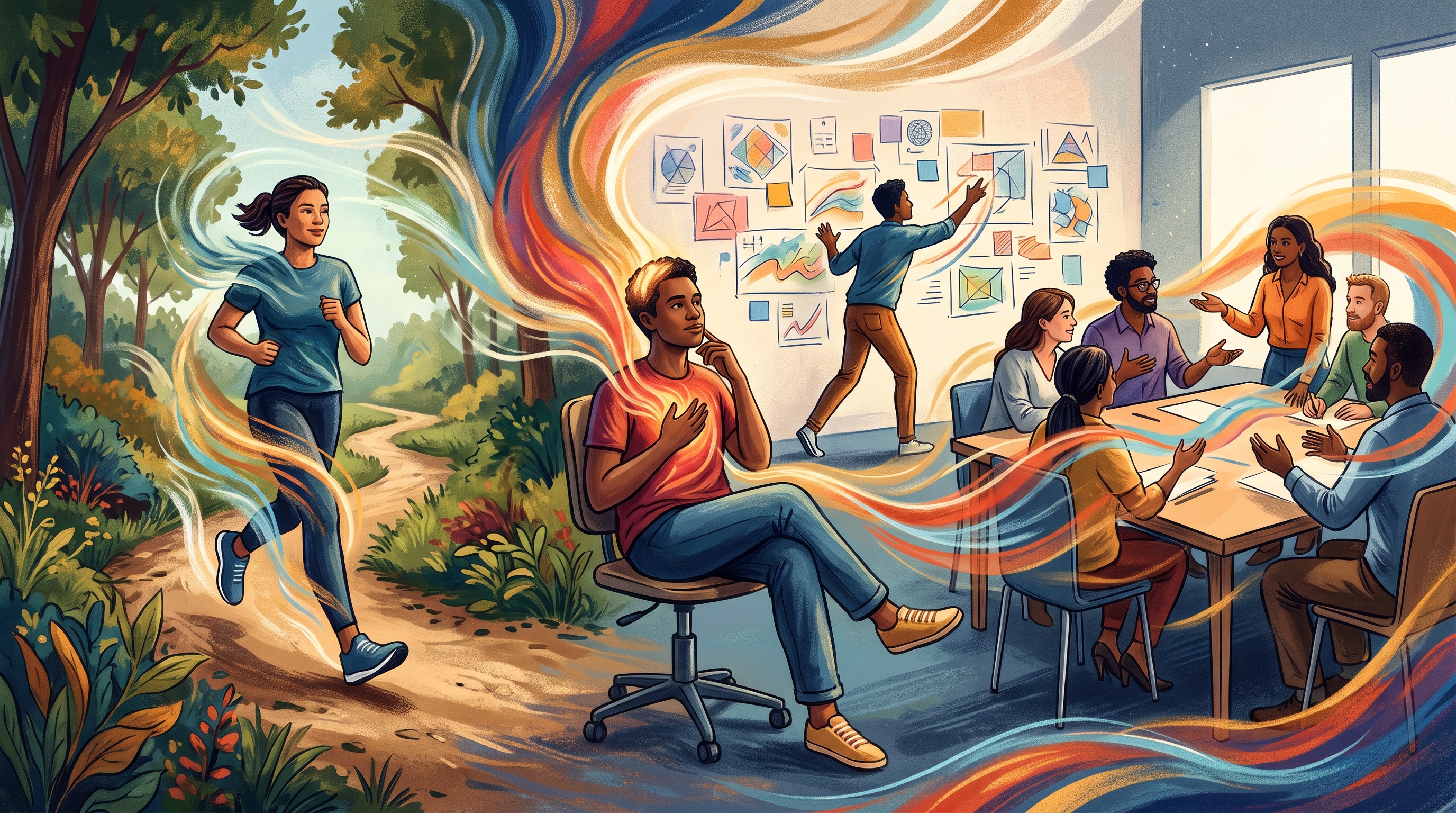
For decades, corporate leadership training has treated emotional intelligence as a purely mental exercise. When stakes rise before a major board presentation, a production outage, or a difficult performance review, the standard advice is simple: stay rational, detach from your feelings, and tell yourself to calm down. We imagine the mind as an executive command center sitting quietly inside the skull, directing the body like a remote operator.
Modern neuroscience and psychology tell a very different story. If we want to elevate how we lead, decide, and collaborate under pressure, we have to abandon the idea that emotional intelligence happens only from the neck up. True emotional mastery begins with understanding how the body builds our feelings, how we can actively reframe physical stress into performance, and how extending our thinking into physical space and social environments unlocks clarity that solitary willpower never will.
Understanding this shift requires correcting a deeply ingrained, inverted model of how emotions work. Most people assume that when we face a stressful event, the brain evaluates the situation, decides which emotion to feel, and then commands the body to respond. Under this view, you feel anxious first, and your heart begins to race second. More than a century ago, American psychologist William James argued that this sequence is completely backwards. Imagine encountering a bear in the forest. Your pulse spikes, your palms sweat, and your legs propel you into a sprint. James observed that we do not run because we feel afraid. Instead, we feel afraid because we notice our racing heart, our trembling hands, and our body fleeing. As he put it, we feel sorry because we cry, angry because we strike, and afraid because we tremble.
Contemporary brain imaging has confirmed and expanded James’s insight. Emotions are not prepackaged reactions triggered automatically by the brain. They are constructed from raw building blocks: the continuous stream of internal physical signals generated by our body, known as interoception, combined with the meanings our upbringing and culture teach us to assign to those signals. This shift in perspective carries two profound implications for leaders. First, the sharper our interoceptive awareness, the richer and more nuanced our emotional data becomes. Second, recognizing that emotions are actively constructed means we are not passive victims of our moods. Once we notice what our body is signaling, we gain the agency to shape what that signal becomes.
That agency matters most when pressure peaks. When a leader steps into a crucial negotiation or prepares to pitch a multiyear transformation roadmap to skeptical executives, their heart hammers and their stomach tightens. Telling yourself to calm down in that moment almost never works, because physiological arousal is already surging. Trying to slam the brakes from intense anxiety straight down to serene calm requires fighting your own nervous system. Psychologists studying emotion construction recommend a far more effective tool called cognitive reappraisal. The process starts with noticing your internal physical state, naming it, and deliberately assigning it a more useful interpretation. Consider the physical footprint of anxiety versus excitement. Both involve a rapid heartbeat, sweaty palms, and heightened alertness. The physical sensation is nearly identical, and the difference lies entirely in the story the brain attaches to it.
Harvard Business School professor Alison Wood Brooks demonstrated this power across a series of revealing experiments. She placed participants in classic stressful scenarios: completing a difficult timed test, delivering an impromptu persuasive speech on how to be an ideal work partner, and singing Journey’s classic rock anthem “Don’t Stop Believin’” in front of strangers. Before starting, participants were instructed either to tell themselves to stay calm or to state aloud, “I am excited”. The results were striking. Those who reappraised their nervous energy as excitement scored higher on the timed test, came across as significantly more persuasive, competent, and confident in their speeches, and even sang more accurately as measured by Nintendo Wii’s Karaoke Revolution software. They did not merely pretend to feel better; they genuinely experienced the moment as energizing rather than threatening.
The same mechanism transforms how we handle chronic workplace stress. In a 2010 study of Boston area university students preparing for the GRE graduate entrance exam, one group read a brief passage explaining that physiological arousal during standardized tests is not harmful and instead sharpens focus and improves performance. The control group received no such message. Three months later, the students who reframed their stress as a performance asset scored an average of 65 points higher than their peers. Effective leaders do not eliminate pressure. They reinterpret the body’s stress response as fuel for sharper execution.
Treating the brain as an isolated computer also ruins how knowledge workers manage energy throughout the day. When mental fatigue sets in during an intense afternoon of strategic planning or system design, most professionals reach for a quick digital break. They scroll through news headlines, check social feeds, or skim messaging apps, assuming they are giving their minds a rest. In reality, scrolling relies on the exact same neural networks and attentional resources required for deep cognitive work. You return to your desk just as drained as before, and often more fragmented. Rather than sitting motionless with another cup of coffee before tackling a complex problem, a brief movement break changes the equation. Going for a brisk walk around the block or through a nearby park physically primes the brain to return sharper than when you left.
Intensity matters just as much as movement itself. While walking along the coastal hills of California, Nobel laureate Daniel Kahneman noticed that walking too quickly severely disrupted his ability to think coherently. Research confirms that the relationship between physical exertion and cognitive performance takes the shape of an inverted U. Moderate movement hits the sweet spot for clear, analytical reasoning. Pushing into sustained, vigorous exercise temporarily loosens tight cognitive control, which is counterproductive for detailed spreadsheets yet remarkably fertile for creative breakthroughs. Smart leaders stop treating their brains like machines to be whipped into submission and start treating them as organs sensitive to context, deliberately matching their physical state to the task ahead.
Looking more broadly at human evolution reveals why our minds struggle when confined to stationary desks and glass conference rooms. Human brains did not evolve to sit still processing abstract spreadsheets for ten hours a day. Our minds evolved to sense a living body, navigate the physical world, and coordinate with other people. Civilization built vast towers of abstract logic on top of those ancient foundations, yet when problems become genuinely complex, the most effective path forward is to translate abstract challenges back into the physical, spatial, and social formats our brains handle best.
The first step is bringing the body back into our decisions. Modern organizations rightly celebrate rigorous data analysis, yet pure reliance on dashboards often blinds leaders to valuable interoceptive cues. Paying attention to gut resistance during a vendor review, or noticing subtle shifts in posture and hand gestures across a meeting room, restores access to human communication systems that predate spoken language. Even our everyday business metaphors, such as moving a project forward or falling behind schedule, reveal that the brain still processes abstract strategy through physical motion.
The second step is turning complex information back into physical space. Philosopher Andy Clark describes humans as inheriting a “brain on legs,” wired to chart paths and store knowledge as mental maps. When teams struggle to align on dense written documents, moving the work onto physical whiteboards, architectural diagrams, or spatial concept maps engages our innate directional instincts. Seeing dependencies laid out across a wall allows leaders to spot bottlenecks and tradeoffs far faster than scrolling through endless paragraphs of text.
The third step is restoring the social nature of our thinking. Much of the quiet chatter running inside our heads is simply internalized dialogue, and most workplace artifacts, from proposals to quarterly reviews, are written for an imagined audience. Converting solitary analysis back into live human interaction changes how the brain processes the exact same facts. Debating a technical design with a peer, mentoring a junior colleague, or building shared physiological rapport with a team over a lively lunch or spicy meal activates social intelligence that isolated solo work can never replicate.
Ultimately, building deeper emotional and cognitive intelligence requires stepping back and asking what kind of creature we actually are. As Andy Clark observed, computer scientists do not build machines meant to calculate for a moment, print out a rough draft, examine the paper, patch the gaps, circulate it to colleagues, and repeat the cycle. Yet that exact iterative loop is how human minds do their finest work. Emotional intelligence in the modern workplace is no longer just about maintaining a poker face in tense meetings. It is about tuning into the quiet signals of your own body, reframing nervous energy into readiness, stepping away from the screen to reset through movement, and intentionally weaving physical space and human dialogue into how you think. When leaders stop trying to force brilliance inside a closed head and start designing intentional loops between body, environment, and team, clarity stops being a rare accident and becomes a repeatable practice.