Artificial intelligence is changing technology faster than most organizations can absorb. Cloud platforms evolve continuously. Cybersecurity threats emerge daily. Business models that dominated an industry yesterday can become liabilities tomorrow. Yet despite investing billions in digital transformation, many organizations still treat learning as an event rather than as part of work itself.
This is one of the greatest misconceptions of modern management.
As Enterprise Architects, we spend considerable effort designing target architectures, governance frameworks, technology standards, and operating models. Yet none of these remain relevant unless the people operating them evolve just as quickly. The true architecture of a modern enterprise is not merely its applications or platforms. It is its capacity to continuously learn.
Peter Drucker observed that productive work requires three inseparable elements: productive work itself, meaningful feedback, and continuous learning. Remove any one of these, and performance eventually stagnates. This insight is even more relevant in today’s AI-driven economy, where the competitive advantage of an enterprise is increasingly determined not by what it already knows, but by how quickly it can learn.
Many organizations still follow what might be called the traditional learning model. Employees attend certification courses, complete mandatory compliance training, or participate in annual development programs. Learning occurs before work begins or when someone changes roles. Once competency has been achieved, the assumption is that the employee has reached an acceptable level of expertise until another formal training opportunity arises.
This model worked when industries changed slowly.
It does not work when technology changes every quarter.
The Japanese philosophy of continuous learning offers a fundamentally different perspective. Learning is not preparation for future work; it is an integral part of current work. Every employee, from frontline workers to senior executives, continuously improves their understanding of how the entire organization operates. Learning becomes embedded in daily operations rather than separated from them.
The objective is not simply acquiring new skills.
It is expanding perspective.
Instead of asking, “What course should I attend next?” employees ask, “How can I perform today’s work better than yesterday?”
This subtle shift changes everything.
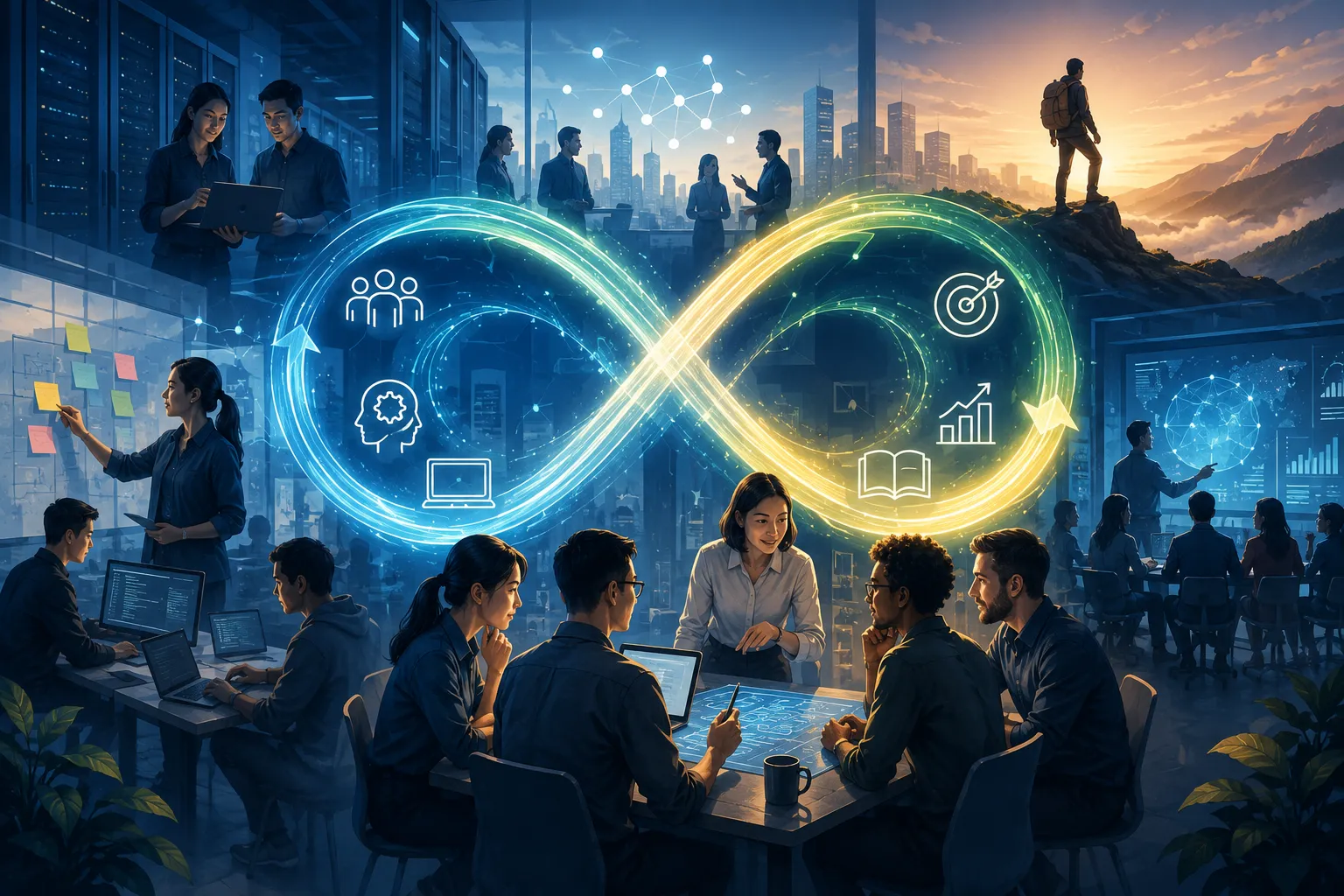
Imagine an engineering team where infrastructure engineers regularly learn about customer journeys, product managers understand deployment pipelines, cybersecurity specialists participate in operational reviews, and architects join incident retrospectives—not as auditors, but as learners. Every participant develops a broader understanding of how value is created across the enterprise.
Enterprise Architecture has always emphasized systems thinking. Continuous learning extends systems thinking from technology to people.
Organizations frequently complain about functional silos, disconnected teams, and poor collaboration. Ironically, many reinforce these problems by limiting learning to individual specializations. Specialists become increasingly specialized, while their understanding of adjacent domains gradually disappears.
The result is predictable.
Solutions become locally optimized but globally inefficient.
Enterprise Architects often describe the enterprise as an interconnected system of business capabilities, processes, information, technology, and people. Yet many organizations educate employees as though these components exist independently. Continuous learning reconnects them.
When people understand the broader system rather than only their own responsibilities, better decisions emerge naturally.
This is particularly important as artificial intelligence becomes deeply integrated into enterprise operations.
AI dramatically lowers the cost of acquiring information, generating software, producing documentation, and automating routine decisions. Ironically, this makes human learning even more valuable—not less.
The differentiator is no longer access to knowledge.
It is the ability to apply knowledge across contexts.
Architects who understand business strategy, data governance, cybersecurity, organizational behavior, regulatory constraints, and emerging technologies will consistently outperform specialists who master only one discipline. AI can generate architecture diagrams. It cannot replace architectural judgment developed through continuous exposure to diverse problems.
Continuous learning therefore becomes the mechanism that strengthens human decision-making rather than competing with artificial intelligence.
Another overlooked aspect of continuous learning is feedback.
Many organizations measure performance primarily for management reporting. Dashboards flow upward. KPIs satisfy executives. Monthly reports disappear into presentation decks.
But feedback was never intended merely for management oversight.
Its greatest value lies in enabling self-management.
When workers receive timely, relevant, and actionable information about their own performance, they naturally begin improving it. Delivery teams that visualize deployment frequency, lead time, defect escape rates, customer satisfaction, and operational resilience do not need constant managerial intervention. They develop ownership because the information becomes a tool for self-direction rather than external control.
Enterprise Architecture has traditionally focused on governance through standards.
Modern architecture should increasingly focus on governance through feedback.
Architects should ask not only whether governance controls exist, but whether teams possess sufficient visibility to govern themselves.
Perhaps the most profound outcome of continuous learning is its relationship with innovation.
Many executives believe employees resist change.
Often they resist confusion rather than change itself.
Organizations that continuously expose employees to new ideas, technologies, customer insights, operational improvements, and cross-functional perspectives gradually normalize adaptation. Innovation stops feeling disruptive because learning has already become part of everyday work.
In these environments, improvement is expected.
Questions become more valuable than answers.
Experiments become more valuable than assumptions.
Progress becomes more valuable than perfection.
This also changes the role of Enterprise Architecture.
Instead of acting primarily as technology governance, Enterprise Architecture becomes the organizational capability that accelerates learning across business and technology. Architecture reviews evolve from approval gates into learning forums. Reference architectures become living knowledge assets rather than static documentation. Communities of practice become engines for organizational memory instead of informal discussion groups.
The best architectures are not those that eliminate uncertainty.
They are those that enable organizations to learn faster than uncertainty evolves.
Perhaps the most dangerous phrase in any enterprise is, “We’ve always done it this way.”
Continuous learning replaces that mindset with a far more powerful question:
“What have we learned this week that will make everyone more effective next week?”
For Enterprise Architects, this may be the most important design principle of all.
Because sustainable competitive advantage is no longer built by designing systems that never change.
It is built by designing organizations that never stop learning.