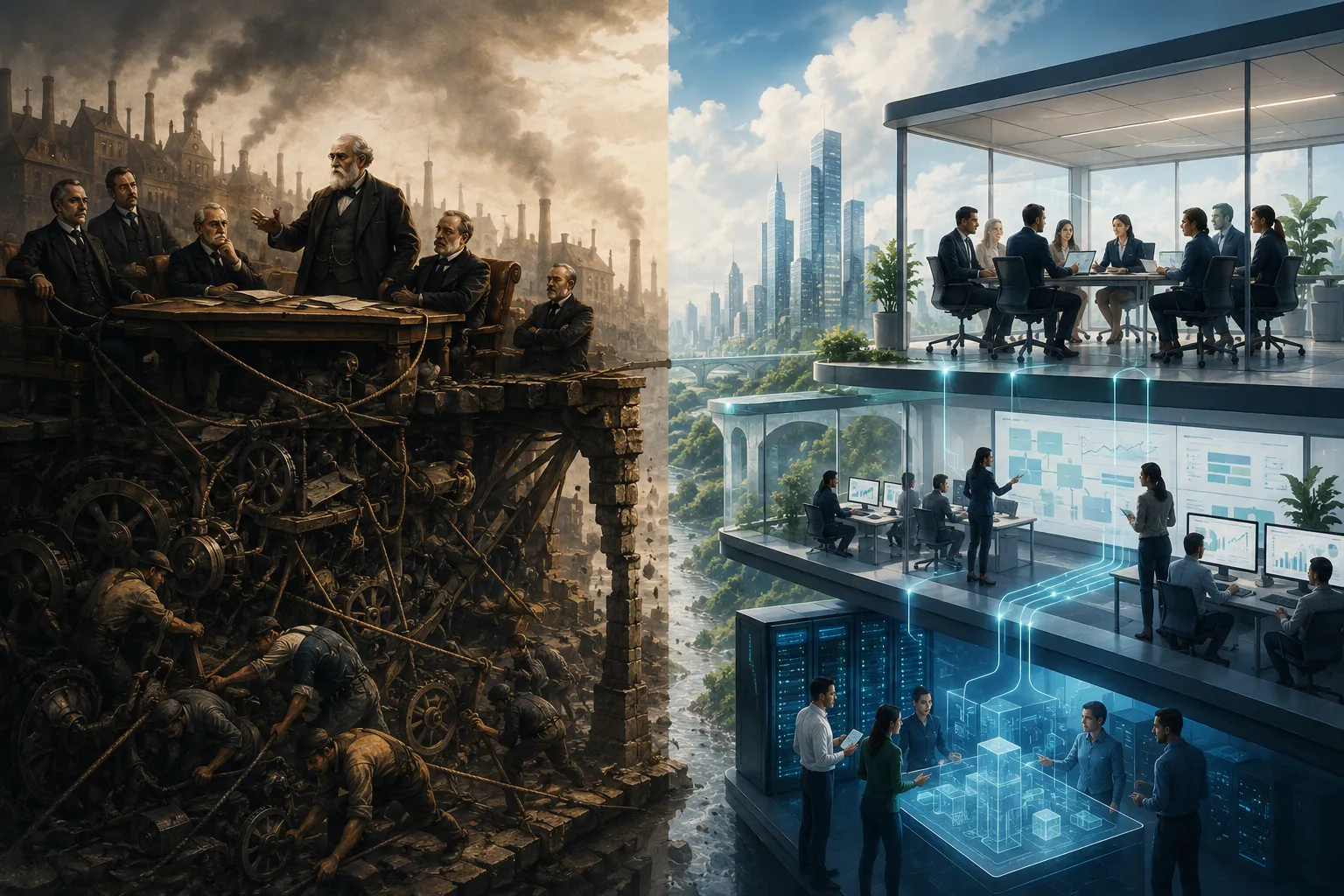
Technology captures headlines. Artificial intelligence dominates boardroom agendas. Digital transformation fills strategic roadmaps. Yet history repeatedly demonstrates that technology alone has never guaranteed sustained leadership. The enterprises that endure are not those with the most advanced tools, but those with the strongest management systems.
As Enterprise Architects, we spend considerable effort designing business capabilities, operating models, governance structures, and technology platforms. However, architecture ultimately succeeds or fails based on one often overlooked capability: management itself.
One of history’s most instructive lessons comes from the decline of British industrial leadership during the late nineteenth and early twentieth centuries. While it is impossible to prove with certainty, there is a compelling argument that Britain’s loss of economic dominance was driven less by technological inferiority than by managerial inadequacy. As enterprises became larger and increasingly complex, many organizations failed to evolve from founder-led businesses into professionally managed enterprises.
Instead of redesigning organizational structures to match growing complexity, many companies adopted compromises. Boards of directors became hybrids, serving simultaneously as owners, supervisors, and operational managers. Responsibilities blurred. Authority became ambiguous. Decision-making slowed as personal influence replaced institutional accountability.
Contrast this with the evolution of leading industrial enterprises elsewhere. Professional management became a distinct organizational capability. Ownership remained important, but ownership no longer determined operational authority. Finance, governance, and executive management each assumed clearly defined responsibilities. Professional managers were appointed because of competence rather than family ties or shareholder status, and leadership became a coordinated team with explicit functions, measurable objectives, and shared accountability.
This distinction remains remarkably relevant today.
Many organizations embarking on digital transformation unknowingly repeat the same historical mistake. They invest heavily in cloud platforms, artificial intelligence, data engineering, and automation while leaving their management structures virtually unchanged. New technologies are layered upon outdated decision-making models. Digital initiatives cross organizational boundaries, but authority remains fragmented across functional silos. Transformation offices are established without corresponding changes to governance. Committees proliferate while accountability diminishes.
The consequence is predictable.
Different business units pursue conflicting priorities. Technology teams optimize for engineering excellence. Business leaders optimize for quarterly targets. Risk teams optimize for compliance. Finance optimizes for cost efficiency. Each function succeeds according to its own metrics while the enterprise as a whole struggles to achieve coherent outcomes.
When organizations operate at different speeds toward different objectives, success increasingly depends on satisfying individual executives rather than delivering enterprise value. Political alignment becomes more valuable than operational performance. Employees learn that managing upward is rewarded more consistently than solving customer problems. Innovation slows not because people lack talent, but because the management system rewards local optimization instead of enterprise effectiveness.
Enterprise Architecture exists precisely to prevent this outcome.
Architecture is fundamentally the design of organizational coherence. While technology architecture often receives the greatest attention, enterprise architecture encompasses operating models, governance, decision rights, business capabilities, information flows, and management structures. The objective is not merely technical integration but managerial integration.
An effective architecture ensures that authority aligns with responsibility, that governance accelerates rather than impedes decisions, and that every management layer contributes measurable value instead of introducing unnecessary complexity.
History also offers another important lesson through Henry Ford. Ford revolutionized manufacturing, yet he remained deeply reluctant to embrace professional management. Distrusting managers and centralizing authority around himself, he often assigned responsibilities without corresponding authority, fostered uncertainty, and unintentionally discouraged capable leaders from exercising independent judgment. The consequence was organizational confusion despite extraordinary products and engineering excellence.
This pattern still appears in modern enterprises. Founder-led organizations often struggle as they scale because leadership continues to rely on personal oversight rather than institutional management. Every important decision requires executive approval. Senior leaders become bottlenecks. Managers become coordinators rather than decision-makers. High performers lose motivation because accountability is unclear, while executives become overwhelmed because they cannot effectively delegate.
Management is not bureaucracy. Properly designed management reduces bureaucracy by creating clarity. It establishes who makes decisions, who owns outcomes, how conflicts are resolved, and how strategic intent translates into operational execution. The larger and more complex an enterprise becomes, the more essential this capability becomes.
This is why Enterprise Architects should view management as an architectural capability rather than simply an organizational function. Just as applications require modular design and infrastructure requires scalability, enterprises require management systems that can scale with organizational complexity. Governance, delegation, accountability, portfolio management, capability ownership, and performance measurement are architectural building blocks every bit as important as APIs, cloud platforms, or data architectures.
The work of management cannot be avoided. Every enterprise performs it, whether intentionally or accidentally. The only question is whether management is designed systematically or allowed to emerge through informal relationships, historical compromises, and organizational politics.
History suggests that enterprises rarely decline because they lack intelligence, capital, talented people, or innovative technology. More often, they decline because their management systems fail to evolve as complexity increases.
For today’s Enterprise Architect, this is perhaps the most enduring lesson: sustainable competitive advantage is not created by technology alone. It is created when strategy, organizational structure, governance, and management evolve together. Technology may enable transformation, but management determines whether transformation becomes lasting enterprise capability.