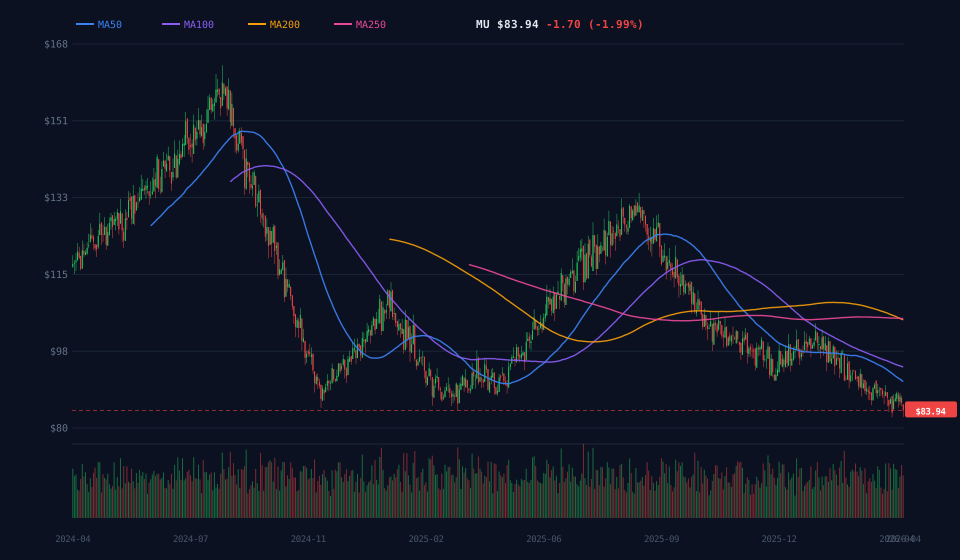
MU · Daily OHLCV · Apr 2024 – Apr 2026 · Moving averages: MA50 (blue), MA100 (purple), MA200 (amber), MA250 (pink)
Company Overview
Micron Technology, Inc. (NASDAQ: MU) is one of the world’s largest producers of DRAM (Dynamic Random-Access Memory) and NAND flash memory. Founded in 1978 and headquartered in Boise, Idaho, Micron supplies memory and storage components to data centre operators, PC and mobile OEMs, automotive manufacturers, and industrial customers.
The company’s product portfolio spans:
- DRAM — commodity and specialty modules, High-Bandwidth Memory (HBM) for AI accelerators
- NAND flash — SSDs (consumer, client, enterprise), managed NAND
- NOR flash & Specialty — automotive and embedded solutions
Recent Performance & Financial Highlights
Micron has navigated a highly cyclical industry. After the severe memory downturn of 2022–2023, the recovery accelerated through 2024–2025, driven primarily by surging demand for HBM chips used in AI training clusters (NVIDIA H100/H200, AMD MI300X).
| Metric | Value |
|---|---|
| Revenue (TTM) | $27.68B |
| Gross Profit (TTM) | $9.75B |
| Gross Margin | ~35.2% |
| Net Profit Margin | 14.7% |
| Revenue Growth (YoY) | +38.1% |
| EPS (TTM) | $4.96 |
| Return on Equity | 11.9% |
Micron reported record HBM revenue in its fiscal Q2 2025, with full-year HBM supply already sold out. The company has committed to significant CapEx to expand its HBM and advanced DRAM capacity at its fabs in Boise, Hiroshima, and the new Greenfield CHIPS Act facility in Syracuse, New York.
Valuation
At the current price of $83.94, MU trades at a significant discount to the broader semiconductor sector:
| Valuation Metric | MU | Sector Median |
|---|---|---|
| Forward P/E | 11.2x | ~22x |
| PEG Ratio | 0.86 | ~1.5x |
| Price / Book | 1.72x | ~4.0x |
| Price / Sales | ~3.4x | ~7.0x |
The PEG ratio below 1 suggests the market is pricing in below-trend earnings growth for the next cycle, despite analyst consensus pointing to continued HBM and data-centre DRAM expansion through at least 2027.
Strategic Positioning in AI
High-Bandwidth Memory is the pivotal growth driver for Micron through the current cycle. Key points:
- HBM3E production ramp — Micron was first to mass-produce HBM3E and ships to major hyperscaler GPU partners. HBM carries ~5× higher revenue per bit than commodity DRAM.
- CHIPS Act tailwind — the $6.1B federal grant supports construction of two leading-edge DRAM fabs in New York, expected to come online 2027–2028.
- Data-centre DRAM mix shift — enterprise and cloud DRAM now exceeds 50% of DRAM revenue, improving pricing power vs. consumer cycles.
- AI edge & automotive — LPDDR5X for on-device AI inference (smartphones, PCs) and UFS 4.0 for automotive ADAS represent additional secular growth vectors.
Investment Thesis
Bull case: Memory cycles are shorter and shallower than in the 2010s due to supply discipline. HBM is supply-constrained through 2026, providing above-cycle margins. Valuation is near trough. Catalyst: Q3 FY2026 earnings beat driven by HBM ASP strength.
Bear case: PC and mobile DRAM end-markets remain soft. Trade restrictions on China (≈10% of Micron’s revenue) have created structural headwinds. New fab capacity coming online in 2026–2027 risks triggering another oversupply cycle.
Analyst consensus: Moderate Buy · 12-month price target consensus ~$115–$125 · upside ~37–49% from current levels.
Key Risks
- Cyclicality — memory is one of the most cyclical segments in semiconductors; margins can swing from ~50% to negative within 18 months.
- China exposure — Micron was banned from certain Chinese infrastructure projects in 2023; further geopolitical escalation remains a tail risk.
- HBM competition — Samsung and SK Hynix are aggressively ramping HBM3E and HBM4 capacity; pricing erosion is possible by late 2026.
- CapEx intensity — the CHIPS Act fabs require multi-billion-dollar outlays; execution risk on ramp timelines could weigh on free cash flow.
- AI capex cycle moderation — if hyperscaler GPU buildout slows, HBM demand could disappoint consensus expectations.
Data above is illustrative. Re-run scripts/fetch_mu_stock.py to refresh the chart and metrics with live market data. This post is for informational purposes only and does not constitute investment advice.